


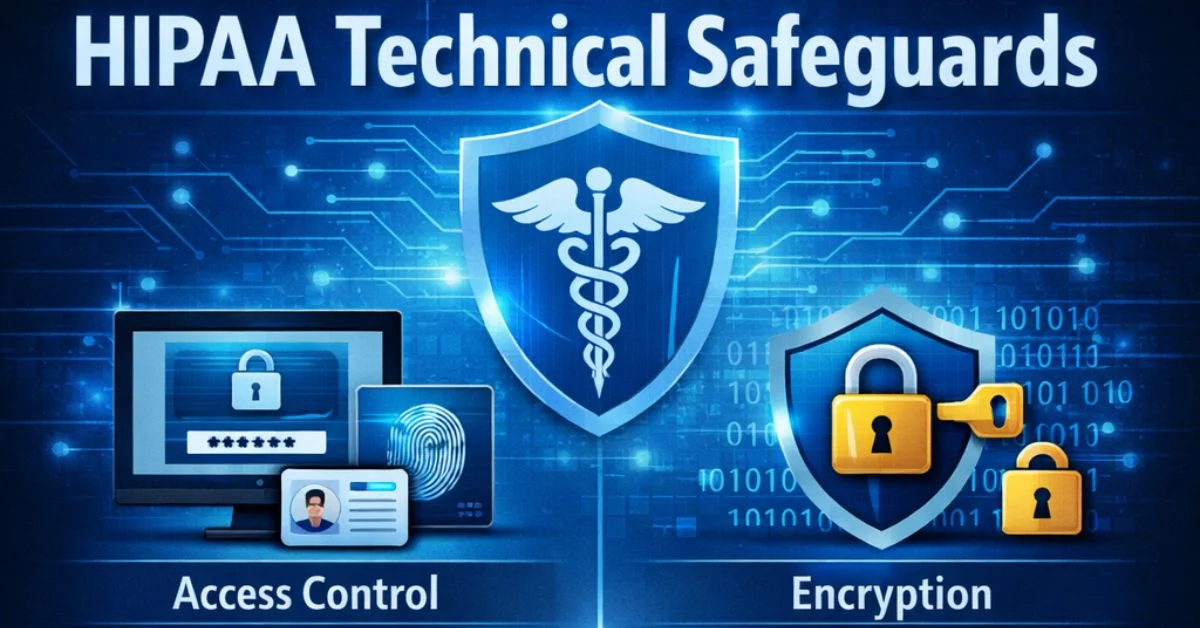
The Department of Health and Human Services Office for Civil Rights launched a Risk Analysis Initiative in fall 2024, resulting in seven enforcement actions by March 2025. One organization paid $227,816 for inadequate HIPAA technical safeguards. These technology-based security measures protect electronic protected health information from unauthorized access, breaches, and cyber threats. Regulators no longer accept checkbox compliance. They expect encryption, multi-factor authentication, comprehensive audit trails, and documented risk management.
Also Read:
TL;DR: HIPAA Technical Safeguards
HIPAA technical safeguards are technology-based security measures protecting electronic protected health information through five core standards: access control, audit controls, integrity controls, authentication, and transmission security. OCR closed 9 investigations with financial penalties by May 2025, primarily targeting failures in security risk analyses and technical safeguard implementation. Encryption is becoming mandatory for all ePHI at rest and in transit under proposed 2025 updates, eliminating the addressable designation. Organizations must implement unique user identification, multi-factor authentication, automatic logoff, comprehensive audit logging, and secure transmission protocols to avoid penalties and breaches.
Key Points:
- Enforcement is intensifying: OCR closed 9 investigations with financial penalties by May 2025, primarily targeting failures in security risk analyses and technical safeguard implementation
- Encryption is mandatory: Both data at rest and in transit require protection through robust encryption protocols, with mandatory encryption requirements eliminating the addressable designation
- Access controls prevent breaches: Unique user identification, multi-factor authentication, and automatic logoff mechanisms reduce unauthorized access risks
- Audit trails demonstrate compliance: Comprehensive logging of system activity enables incident detection and regulatory verification
- Modern challenges demand updated approaches: Cloud computing, remote work, mobile devices, and AI systems require tailored technical safeguard strategies
What Are HIPAA Technical Safeguards?
Technical safeguards are technology and policies that protect electronic protected health information and control access to it. The HIPAA Security Rule at 45 CFR § 164.312 establishes five standards: access control, audit controls, integrity controls, person or entity authentication, and transmission security.
These safeguards work together to create layered protection. Access control restricts who can view or modify ePHI. Audit controls track all system activity involving sensitive information. Integrity controls ensure data remains accurate and unaltered. Authentication verifies user identities. Transmission security protects information moving across networks.
Required vs. Addressable Specifications
HIPAA distinguishes between required and addressable implementation specifications. Required specifications must be implemented exactly as written. Organizations must assign unique user identifications and establish emergency access procedures without exception.
Addressable specifications historically offered flexibility based on risk assessments, but regulatory trends increasingly expect their implementation. Organizations must implement them if reasonable and appropriate, or adopt equivalent alternatives. When an addressable specification isn’t implemented, organizations must document reasoning and describe alternative protections. The landscape is shifting: mandatory encryption requirements in proposed 2025 updates would eliminate encryption’s addressable status.
Technical vs. Administrative and Physical Safeguards
| Safeguard Type | What It Protects | How It Works | Example |
| Technical | ePHI through technology | Access controls, encryption, audit logs | Multi-factor authentication, TLS encryption |
| Administrative | ePHI through policies | Workforce training, risk assessments, procedures | Password policies, security training programs |
| Physical | ePHI through facility controls | Building access, workstation security, device disposal | Locked server rooms, badge access systems |
All three categories must work together for comprehensive HIPAA compliance.
Why Technical Safeguards Matter More in 2025
Hacking and IT incidents accounted for 87.9% of healthcare breaches in August 2025, affecting over 3.6 million individuals in a single month. Regulators responded by intensifying oversight and proposing stricter technical requirements. The proposed 2025 HIPAA Security Rule updates would eliminate many addressable specifications, making encryption and multi-factor authentication mandatory across all systems.

Access Control Standards
The regulation at 45 CFR § 164.312(a)(1) requires technical policies and procedures that restrict ePHI access to authorized individuals only. A mid-sized healthcare provider with outdated legacy IT systems lacked role-based access control, leaving patient data vulnerable. They deployed centralized identity management via Azure AD and Okta, implementing role-based access that granted staff only the permissions necessary for their job functions.
Unique User Identification (Required)
This required specification assigns each person a distinct name or number for tracking user identity. Shared accounts eliminate accountability and prevent accurate audit trails. When multiple people share credentials, organizations cannot determine who accessed specific patient records.
Implementation involves:
- Creating individual usernames for every staff member
- Provisioning new accounts when employees join
- Modifying access when roles change
- Deactivating credentials within 24 hours of termination
A 2024 enforcement case revealed a clinic’s billing staff maintained access to full patient records 18 months after role changes. Investigators discovered 12 former employees with active credentials during an OCR audit. Regular quarterly access reviews prevent violations by exporting all active accounts, comparing against HR records, and requiring manager attestation for every active credential.
Emergency Access Procedures (Required)
Emergency access procedures ensure authorized personnel can retrieve necessary ePHI during crises when normal access controls might fail. Power outages, system failures, or natural disasters shouldn’t prevent clinicians from accessing life-critical patient information. Organizations must document break-glass procedures that enable emergency access while maintaining security. Every emergency access event must be logged and reviewed afterward to verify legitimate use.
Automatic Logoff (Addressable)
Automatic logoff terminates electronic sessions after predetermined periods of inactivity, preventing unauthorized access to unattended workstations. A nurse stepping away from a computer for five minutes shouldn’t leave patient records vulnerable to casual viewing. Organizations must determine appropriate timeout periods that balance security with workflow efficiency.
Encryption and Decryption (Addressable)
While 45 CFR § 164.312(e)(2)(ii) classifies encryption as addressable, mandatory encryption requirements are eliminating this flexibility. Organizations must encrypt data both at rest on servers, laptops, and mobile devices, and in transit across networks. Implementations across 50+ healthcare organizations show that AES-256 encryption adds less than 3% performance overhead.
Encryption Implementation Requirements:
| Component | Standard | Application | Key Management |
| Data at rest | AES-256 | Servers, laptops, mobile devices, backups | 90-180 day key rotation |
| Data in transit | TLS 1.2+ | Network traffic, email, file transfers | Certificate renewal every 12 months |
| Database encryption | AES-256 | EHR systems, billing databases, patient portals | Separate key storage from encrypted data |
Key management presents the biggest challenge. Establish a documented key rotation schedule and maintain offline key backups in physically secured locations. Losing encryption keys makes data permanently inaccessible.

Audit Control Standards
Audit controls record system activity involving ePHI. The regulation requires implementing hardware, software, or procedural mechanisms that record and examine activity in systems containing or using ePHI. These logs serve dual purposes: detecting security incidents in real-time and providing evidence during compliance audits.
A typical 100-physician practice generates 50GB of logs monthly. Focus initial monitoring on high-risk events:
- Failed login attempts after three tries
- After-hours access to more than 10 records
- Bulk exports
- Administrative privilege use
This targeted approach catches 95% of incidents while requiring only 2-3 hours weekly review time.
What Activities Must Be Logged
Organizations must log sufficient activity to reconstruct security events and user actions. At minimum, audit trails should capture:
Application-Level Logs:
- Which ePHI files were opened, read, edited, or deleted
- Timestamps for all file access
- User IDs performing actions
System-Level Logs:
- Successful and failed login attempts
- Source IP addresses
- Devices used to access systems
User Audit Trails:
- Specific commands executed
- Resources accessed by individuals
- Automated system activities
Audit Log Retention and Review
Organizations must retain audit logs for at least six years to align with HIPAA documentation requirements. Logs must be protected against tampering or deletion through write-once storage or secure backup systems.
Regular log reviews transform passive data collection into active security management. Monthly or quarterly reviews identify trends like increasing failed login attempts indicating credential stuffing attacks. Automated analysis tools flag anomalies requiring investigation, but human review remains essential for interpreting context.
Person or Entity Authentication
Authentication standards at 45 CFR § 164.312(d) require procedures verifying that persons or entities seeking ePHI access are who they claim to be.
Multi-Factor Authentication: From Optional to Mandatory
Multi-factor authentication combines two or more factors: something users know (passwords), something they possess (tokens or smartphones), or something they are (biometrics). MFA dramatically reduces unauthorized access risks because attackers must compromise multiple authentication factors.
MFA Implementation Challenges and Solutions:
| Challenge | Impact | Solution |
| Legacy medical devices lack MFA support | FDA-authorized devices pre-2023 create access vulnerabilities | Migrate ePHI to MFA-compatible assets within 12-24 months |
| Complex healthcare networks with multiple manufacturers | Disjointed devices prevent centralized MFA deployment | Deploy cloud-based MFA tools with automated compatibility checks |
| Older hardware can’t natively support MFA | Equipment upgrades required for compliance | Implement manufacturer-recommended updates post-March 2023 |
Multi-factor authentication requirements are becoming mandatory for all ePHI access points under proposed 2025 updates. Don’t wait for final regulations to implement MFA across your environment.
Transmission Security Standards
Transmission security protects ePHI traveling across networks from unauthorized access or modification. Data transmission creates vulnerability windows when information moves between systems.
Encryption in Transit: No Longer Optional
While classified as addressable, encryption in transit has become effectively mandatory. Mandatory encryption requirements for all ePHI at rest and in transit eliminate this designation under proposed 2025 updates. Transport Layer Security protocols create encrypted tunnels protecting data traversing networks. Organizations must use TLS 1.2 or higher, as older protocols contain known vulnerabilities that attackers actively exploit.
Secure Communication Protocol Requirements:
| Communication Type | Insecure Protocol | Secure Replacement | Implementation |
| Web applications | HTTP | HTTPS (TLS 1.2+) | SSL/TLS certificates on all web servers |
| File transfers | FTP | SFTP or FTPS | Replace FTP servers with secure alternatives |
| SMTP (plain text) | Encrypted email or secure portals | Implement email encryption gateway | |
| Remote access | Telnet, plain RDP | VPN with encryption | Deploy VPN appliance or cloud VPN service |
Network segmentation isolates systems containing ePHI from general networks, limiting breach spread if attackers compromise perimeter defenses.
Implementing Technical Safeguards for Modern Healthcare
Modern healthcare technology environments present implementation challenges that didn’t exist when HIPAA regulations were drafted. Cloud computing, remote work, mobile devices, and artificial intelligence have transformed how organizations store, access, and process ePHI.
Cloud Computing and SaaS Compliance
Cloud service providers handle ePHI for many healthcare organizations, requiring business associate agreements that specify security responsibilities. Not all cloud services meet HIPAA requirements. Organizations must carefully evaluate providers before migrating ePHI.
Cloud Provider Due Diligence Checklist:
- Verify HIPAA compliance history and request attestations
- Confirm SOC 2 Type II or HITRUST certification
- Review data encryption standards (at rest and in transit)
- Examine access control mechanisms and MFA support
- Request audit logging capabilities and retention periods
- Assess incident response and breach notification procedures
- Evaluate physical security measures for data centers
- Review business continuity and disaster recovery capabilities
- Negotiate clear security responsibilities in BAA
Organizations retain ultimate responsibility for ePHI protection even when data resides with third-party providers.
Remote Work Security Implementation
Remote work extends organizational networks into employees’ homes. Organizations must inventory all devices accessing ePHI, including personal devices used through bring-your-own-device policies.
Remote Work Security by Organization Size:
| Organization Size | Timeline | Core Requirements | Estimated Budget |
| Small (<50 employees) | 2-3 months | VPN solution, endpoint protection, remote work policies | $5,000-$15,000 |
| Medium (50-200) | 4-6 months | Centralized identity management, network access control, mobile device management | $25,000-$75,000 |
| Large (200+) | 6-12 months | Zero-trust architecture, user behavior analytics, dedicated security teams | $100,000+ |
Network security extends beyond organizational firewalls when employees access systems from home networks that may lack basic security protections. Require VPN connections for all remote access.
AI Systems: Emerging Technical Safeguard Requirements
Artificial intelligence systems processing ePHI present unique challenges. These systems often need broad data access for training and operation, creating tension with HIPAA’s minimum necessary standard.
AI-Specific Technical Safeguards:
- Implement role-based access restrictions for AI systems
- Apply multi-factor authentication to all AI tool access
- Use mandatory encryption for all ePHI in AI pipelines
- Configure AI systems to process only minimum necessary ePHI
- Maintain comprehensive audit logs of all AI interactions with patient data
- Document model training activities and data governance procedures
- Conduct continuous risk assessments as AI systems evolve
- Train workforce on approved versus unapproved AI tools
The HTI-1 final rule effective January 1, 2025 requires developers of certified health IT to meet new AI-related certification criteria and disclose data sources. Organizations must monitor AI outputs for anomalies and document any discriminatory impacts under the Affordable Care Act Section 1557 amended July 2024.

Common Technical Safeguard Violations
Understanding common violations helps organizations avoid costly penalties and security breaches.
Weak Access Controls
Inadequate access controls enable unauthorized ePHI access through shared accounts, excessive privileges, or failure to terminate access promptly. Organizations must implement role-based access granting minimum necessary permissions. Regular access reviews identify inappropriate privileges or orphaned accounts belonging to former employees.
Insufficient Audit Trails
Many organizations collect audit logs but never review them or lack sufficient detail to reconstruct security events. Logs must capture enough information to determine who accessed what ePHI when and from which device. Regular log reviews transform passive logging into active security monitoring.
Unencrypted Data Transmission
Transmitting ePHI without encryption creates easy interception opportunities for attackers. Organizations have paid substantial penalties for emailing unencrypted patient information. All ePHI transmission must use encrypted protocols like TLS for web traffic, SFTP for file transfers, and VPNs for remote access.
Authentication Failures
Hacking and IT incidents represented 87.9% of breaches in recent months, with many involving compromised credentials. Organizations must implement multi-factor authentication, monitor for credential stuffing attacks, and promptly disable accounts showing signs of compromise.
Top Implementation Challenges and Solutions
Healthcare organizations face consistent obstacles when deploying HIPAA technical safeguards.
Challenge 1: Technology Asset Inventories
Maintaining comprehensive inventories without annual updates hinders visibility. Rapid device proliferation exceeds manual tracking capacity, especially in resource-limited small clinics.
Solution: Implement automated asset management tools for real-time inventories showing all devices connected to networks. Enforce network segmentation policies isolating ePHI systems. Integrate asset inventories with risk assessments for ongoing updates.
Challenge 2: Network Segmentation
Absent segmentation allows breaches to propagate across entire networks, while weak third-party compliance creates vulnerabilities at vendor connection points.
Solution: Deploy zero-trust segmentation creating strong boundaries around health data systems. Audit all vendors annually through revisited business associate agreements. Use automated threat detection for early alerts when unusual traffic patterns suggest breach attempts.
Challenge 3: Incomplete Encryption Coverage
Incomplete encryption across storage, transmission, and multi-portal environments violates 2025 rules. Data silos from unconnected tools outpace legacy encryption setups.
Solution: Conduct full ePHI touchpoint audits identifying every location where patient data exists or travels. Deploy unified platforms with end-to-end encryption rather than patchwork solutions. Use automated cloud tools for compliance verification.
Creating Your Technical Safeguards Action Plan
Organizations need structured approaches for implementing comprehensive technical safeguards. An effective action plan establishes clear priorities, assigns responsibilities, and sets realistic timelines.
Step 1: Conduct Risk Assessment
Document all systems containing ePHI, assess current technical controls, and determine which required and addressable specifications need implementation or strengthening.
Step 2: Set Measurable Goals
Establish concrete targets such as “implement multi-factor authentication for all remote access within 90 days” or “encrypt all laptops and mobile devices within six months.”
Step 3: Assign Clear Ownership
Technical safeguards often require coordination between IT security, system administrators, compliance officers, and clinical leaders. Clearly defined ownership ensures accountability.
Step 4: Develop Phased Timelines
Prioritize addressing known vulnerabilities or required specifications currently lacking implementation. High-risk areas like unencrypted portable devices or missing audit controls demand immediate attention.
Step 5: Allocate Resources
Technical safeguards require initial implementation costs and ongoing maintenance investments. Organizations that underfund security initiatives inevitably face larger expenses from breaches or enforcement penalties.
Step 6: Establish Review Cycles
Quarterly security meetings reviewing recent incidents, emerging threats, and regulatory developments help organizations stay ahead of risks. Annual comprehensive reviews validate that all safeguards remain effective.
Conclusion
HIPAA technical safeguards represent fundamental requirements for protecting patient information in digital healthcare environments. OCR’s Risk Analysis Initiative demonstrates regulators expect comprehensive access controls, audit mechanisms, integrity protections, authentication procedures, and transmission security. The regulatory landscape continues evolving toward stricter enforcement and more prescriptive requirements, particularly around encryption and multi-factor authentication.
Effective implementation requires more than purchasing security software. Organizations must conduct thorough risk assessments, develop tailored policies and procedures, train workforce members, and continuously monitor and improve their security posture.
Tekkis specializes in helping Colorado healthcare organizations navigate HIPAA technical safeguard requirements through comprehensive risk analysis, security implementation, penetration testing, and managed security services. Our team understands the unique challenges healthcare providers face balancing security requirements with operational efficiency and patient care priorities.